
25 September 2026
Wix or Shopify vs Custom Development: What Actually Fits Your Business?
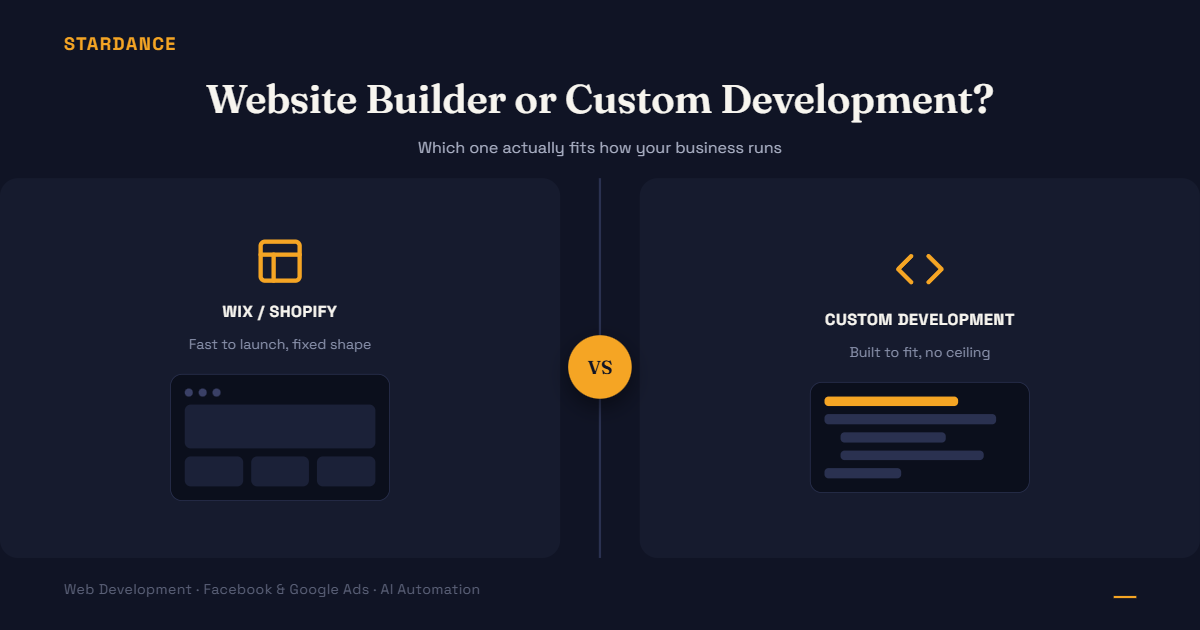
You’ve seen the ads: “build a website in an afternoon.” And for some businesses, that’s genuinely true and the right call. For others, it’s how you end up rebuilding the whole thing eight months later because the platform can’t do what your business actually needs. Here’s how to tell which one you are.
What builders like Wix and Shopify are actually good at
These platforms exist to remove friction for a specific job: getting a standard business online fast, without hiring anyone. They’re a legitimately good fit when:
- You’re validating an idea and need something live in days, not weeks
- Your site is mostly informational with no complex custom logic
- Shopify specifically: you’re selling a straightforward product catalog and don’t need custom checkout logic, unusual inventory rules, or deep integrations with other business systems
- Budget is the primary constraint and “good enough” beats “exactly right”
If that’s your business, paying for custom development is genuinely overkill. This isn’t a “real businesses use custom code” argument. Plenty of profitable Malaysian businesses run entirely on these platforms.
Where builders start costing you more than they save
The friction shows up later, usually in one of these ways:
- Malaysian payment gateway support is limited or clunky. FPX, GrabPay, and Touch ‘n Go integration on Wix/Shopify often means a third-party app, extra transaction fees stacked on top of the platform’s own fees, or a checkout experience that feels bolted-on rather than native.
- You need something the platform’s app marketplace doesn’t cleanly offer. A booking system with specific business rules, a membership tier with custom logic, an integration with your internal systems. You end up stacking multiple paid apps that don’t talk to each other well, patched together instead of built to fit.
- Site speed and SEO plateau. Builder platforms carry a lot of code you’re not using, which shows up as slower load times, and load time is a direct Google ranking factor. Once you’re relying on organic search for leads, this stops being a cosmetic issue.
- You outgrow the template, not just the content. At some point the business needs a specific user flow like a quote calculator, a multi-step application form, or a dashboard for logged-in customers, that a drag-and-drop builder simply wasn’t designed to do.
The actual decision framework
Don’t ask “which platform is better”. Ask these three questions:
- Does my business need custom logic, or just custom content? Custom content (words, images, layout) is what every platform handles. Custom logic (specific rules, calculations, integrations) is what separates them.
- Will Malaysian payment methods need to feel native, not bolted on? If FPX or e-wallet checkout is central to your sales, this alone can justify custom development.
- Am I optimizing for launch speed or long-term cost? A builder is cheaper today and more expensive to migrate away from later. Custom development costs more upfront and scales without a rebuild.
The middle ground people miss
It’s not all-or-nothing. A common, sensible path: launch on a builder to validate the business cheaply, then move to custom development once you have real traffic, real payment volume, or a specific feature request you keep working around. The mistake isn’t choosing a builder. It’s staying on one for two years after it’s visibly costing you leads, sales, or hours of manual workaround every week.
Not sure whether your current site has outgrown its platform, or want a straight opinion on your specific case? [See how we approach custom web development →]