
19 October 2026
Why We Offer Free Demos for Eligible Clients (and How It Works)
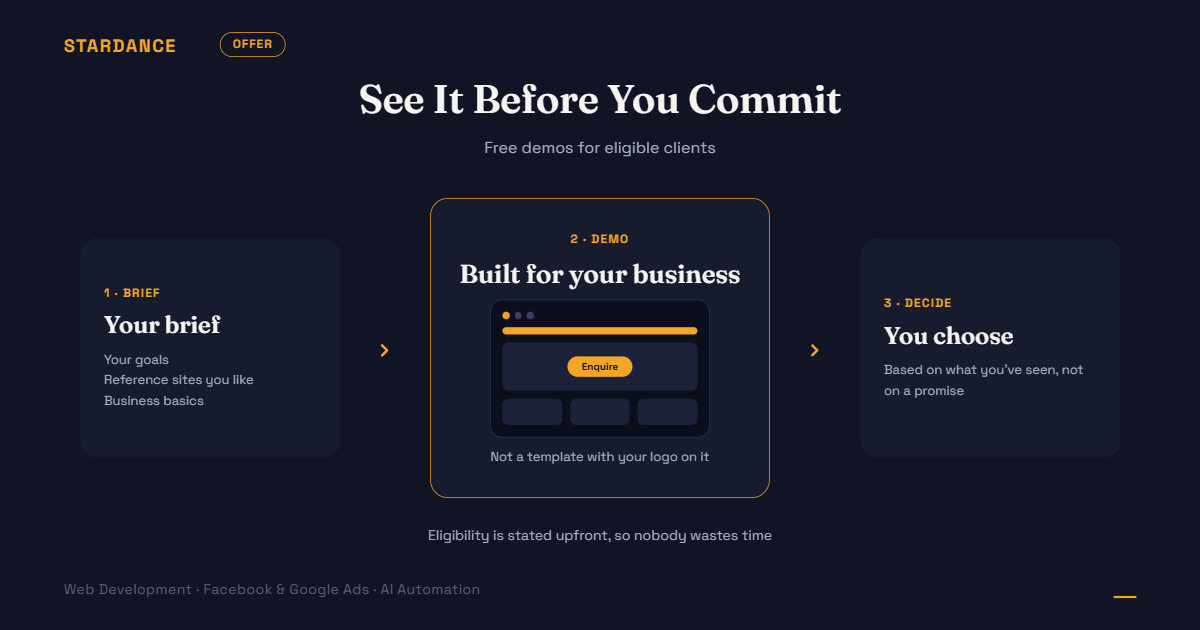
Most agencies ask you to commit before you’ve seen anything. You read a proposal, look at a portfolio of other people’s work, and pay a deposit on a promise. We think that’s the wrong way round, so for clients who qualify, we build a demo first.
Why we do it
1. It’s a fairer way to take a risk. A website, a campaign or an automation is a real investment. A portfolio shows what we did for someone else. A demo shows what we’d do for you, with your business and your customers in mind.
2. It shows how we think, not just how we present. A proposal describes a plan. A demo is evidence of whether we understood your brief, how we handle your constraints, and whether we’d be easy to work with.
3. It catches mismatched expectations early. Many project problems come from two people picturing different things. When a client sends us a reference site and says “like this,” a demo shows what we took from it before any real money is spent. (We wrote about how we handle reference sites in our article on turning them into something original.)
4. It works in both directions. A demo helps us judge fit too. We’d rather find out in week one that we’re not the right team than in month three.
Free to you, not free to us
A demo takes real time from real people, and we won’t pretend otherwise. That’s why it’s offered to eligible clients, not to everyone who asks. We’d rather do fewer demos properly than many that are rushed. If a demo were thin or generic, it wouldn’t help you decide anything.
Who’s eligible
We state the criteria upfront so nobody wastes time. If you don’t qualify for a demo, we’ll say so plainly and suggest another way to evaluate us, such as a call, a short audit, or a smaller first project.
What a demo is, and isn’t
| A demo is | A demo isn’t |
|---|---|
| A working look at how we’d approach your project | The finished product |
| Based on your brief, goals and references | A generic template with your logo on it |
| Enough to judge quality, direction and fit | A full free build in stages |
| A starting point for a conversation | A commitment from either side |
What a demo can look like
It depends on the service.
- Web development: a working preview showing structure, layout and how the enquiry path would work.
- Facebook and Google Ads: a proposed campaign structure with a plan for how results would be tracked.
- AI automation: a working example of the workflow, such as lead routing, using sample data.
- SEO, GEO and AEO: a short review of how your business currently appears in search and AI answers, with first priorities.
How it works
- You share a brief. What you do, who you serve, what you want, and any reference sites you like.
- We check eligibility and confirm what the demo will cover.
- We build it over one to two weeks.
- We walk you through it, explain our choices, and take your feedback.
- You decide.
What we ask of you
A demo only works if the input is real:
- A clear goal, such as more enquiries, online sales or bookings
- Two or three references with a note on what you like about each
- Basic information about your business, services and customers
- A decision-maker who joins the review
- Honest feedback, including “this isn’t right”
How to judge any agency’s free offer
Free offers aren’t all equal, whether they’re ours or someone else’s. Before you accept one, ask:
- What exactly is included, and what isn’t?
- Is it built for you, or is it a template?
- Who owns it if you don’t proceed?
- Is there pressure to decide quickly, or a discount that disappears?
- What happens after the demo, and are there any costs you haven’t been told about?
- Who actually builds it, and will they work on the real project?
A good agency answers these without hesitation. If the answers are vague, treat the “free” label with caution.
Should you ask for one?
If you’re planning a new website, a campaign, an automation or an SEO project and want to see our thinking before committing, ask. If you’re comparing several agencies, ask each for the same kind of demo, because it’s a more reliable comparison than a price list.
Planning a project and want to see our approach before you commit? Tell us what you’re building and we’ll let you know if you’re eligible for a demo. [See how we approach web development projects →]