
14 October 2026
Why Is My Cost Per Lead So High? 7 Common Facebook Ads Mistakes
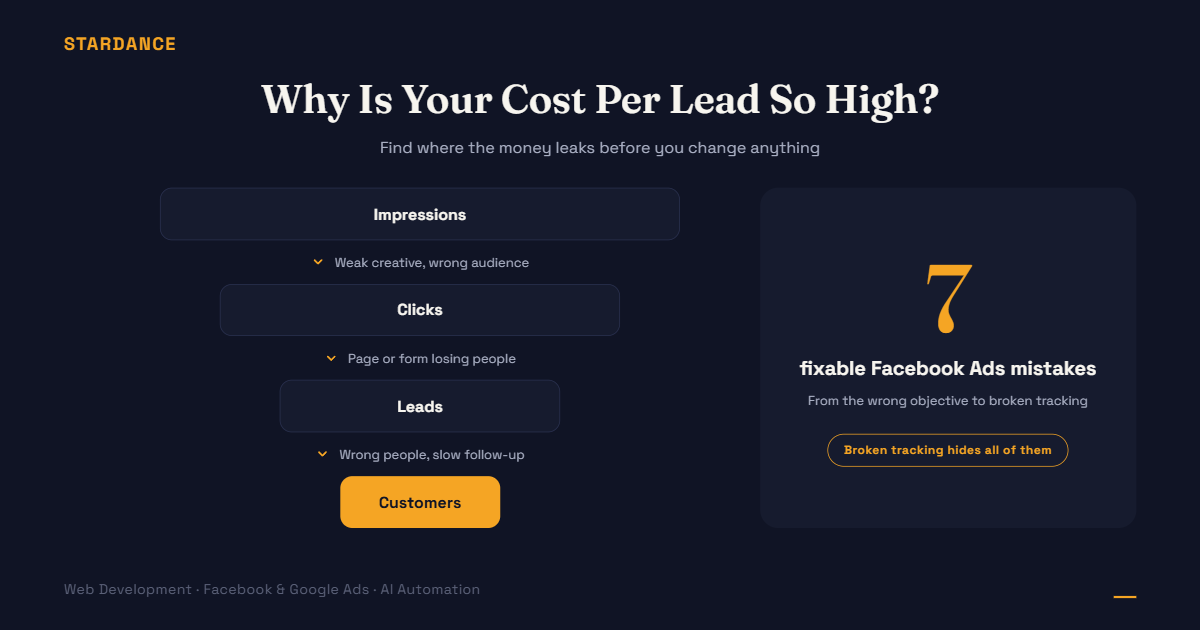
You’re spending on Facebook and Instagram ads, leads are coming in, and every month the cost per lead (CPL) looks higher than it should. Sometimes there’s a competitor to blame or a festive season. Most of the time, though, the cost comes from a handful of fixable mistakes, and they’re easier to find if you know where to look.
Start by finding where the cost is coming from
CPL is simply what you spend divided by the leads you get. But that single number hides four different problems:
| What you see | What it usually means |
|---|---|
| Lots of impressions, few clicks | The ad or audience isn’t interesting to the people seeing it |
| Clicks are expensive | Weak creative, poor targeting, or a crowded audience |
| Plenty of clicks, few leads | The landing page or form is losing people |
| Leads are cheap, but nobody buys | You’re attracting the wrong people |
Work out which row sounds like you before changing anything. The seven mistakes below map onto these.
Mistake 1: Running the wrong campaign objective
If your campaign is set to optimize for traffic, reach or engagement, Facebook will find you people who click or react, not people who fill in forms. You’ll get cheap clicks and expensive leads. The same applies to the Boost button, which is built for engagement (we explain the difference in our post on boosting a post vs running a proper campaign).
Fix: set the objective to leads, or sales if you sell online, and optimize for the action you actually want.
Mistake 2: Splitting a small budget across too many ad sets
Splitting a small budget into five audiences leaves each one with too little spend to learn from. Facebook’s delivery system needs enough results to work out who responds, and thin budgets keep it guessing.
Fix: use fewer ad sets with enough budget each, and consolidate audiences that overlap.
Mistake 3: One creative, never tested
A single image or video, shown to the same people for weeks, wears out. Clicks get more expensive as people tire of seeing it. Without alternatives to compare, you can’t tell what’s working.
Fix: run three or four variations at a time, changing one thing at once: the hook, the image, the offer, or the call to action. For Malaysian audiences, test language too: English, Bahasa Malaysia, or a mix, depending on who you’re targeting. Replace creative that has plateaued.
Mistake 4: Sending clicks to a page that doesn’t match the ad
The ad promises one thing and the page opens on something else, or loads slowly, or hides the form below a wall of text. People leave before enquiring. Because most visitors are on phones, a page that works on desktop but is awkward on mobile quietly raises your CPL.
Fix: match the page to the ad’s promise, put the enquiry action at the top, keep the form short, and test it on a phone. If you want to benchmark the page itself, see our post on how many leads your website should generate, and for the choice between a landing page and a full site, see corporate website vs landing page.
Mistake 5: Weak or missing conversion tracking
If Facebook can’t see which clicks turned into leads, it optimizes for the wrong signals. Missing the Meta Pixel or Conversions API, tracking the wrong event, or counting page views as leads all produce numbers that look fine and mislead you.
Fix: confirm the lead event fires on a real submission, check it against your own records, and make sure WhatsApp clicks and calls are tracked too, since many Malaysian customers prefer to message before filling in a form. If your reported leads and your actual leads don’t match, fix this before touching anything else.
Mistake 6: Changing things too often, or judging too early
Editing budgets, audiences and creative every day resets what the system has learned. Judging results after two days, when numbers are still swinging, leads to decisions based on noise.
Fix: let each change run long enough to gather meaningful results, change one thing at a time, and write down what you changed and when. Decide your review days in advance, for example weekly, instead of reacting to every dip.
Mistake 7: Measuring cost per lead, not cost per good lead
A low CPL means little if the leads never answer, can’t afford what you sell, or came from a form that was too easy to fill in. The reverse also happens: a higher CPL from a stricter form can produce better customers. Slow follow-up makes it worse, because a lead that waits hours often goes elsewhere.
Fix: track what happens after the lead, such as how many are contacted, qualified and converted. Add a qualifying question to the form. Respond fast: routing enquiries automatically to the right person with an instant WhatsApp alert closes the gap that costs you the most.
Not every spike is your fault
Costs usually rise during peak periods like Hari Raya, Chinese New Year, 11.11 and year-end sales, when more advertisers compete for the same audiences. Compare this month with the same period last year, or with a similar week, before concluding something is broken. If you know a peak is coming, plan budgets and creative early, or shift effort to periods when competition is lower.
A 15-minute check you can do today
- Confirm the campaign objective matches what you want.
- Count your active ad sets and compare against your daily budget.
- Check how many ad variations you have and how old they are.
- Open the landing page on your phone and try to enquire.
- Compare leads reported in Ads Manager with leads actually received.
- Look at what happened to last month’s leads.
If two or three of these fail, you’ve found where your money is going.
When to get help
If you’ve gone through this list and the numbers still don’t make sense, an audit usually finds the cause in a few hours, often in the tracking or landing page rather than the ads themselves.
Not sure why your cost per lead keeps climbing, or want your campaigns and tracking checked before you spend more? [See how we run Facebook and Google Ads campaigns →]