
13 October 2026
Signs It’s Time to Hire a Digital Agency Instead of Building an In-House Team
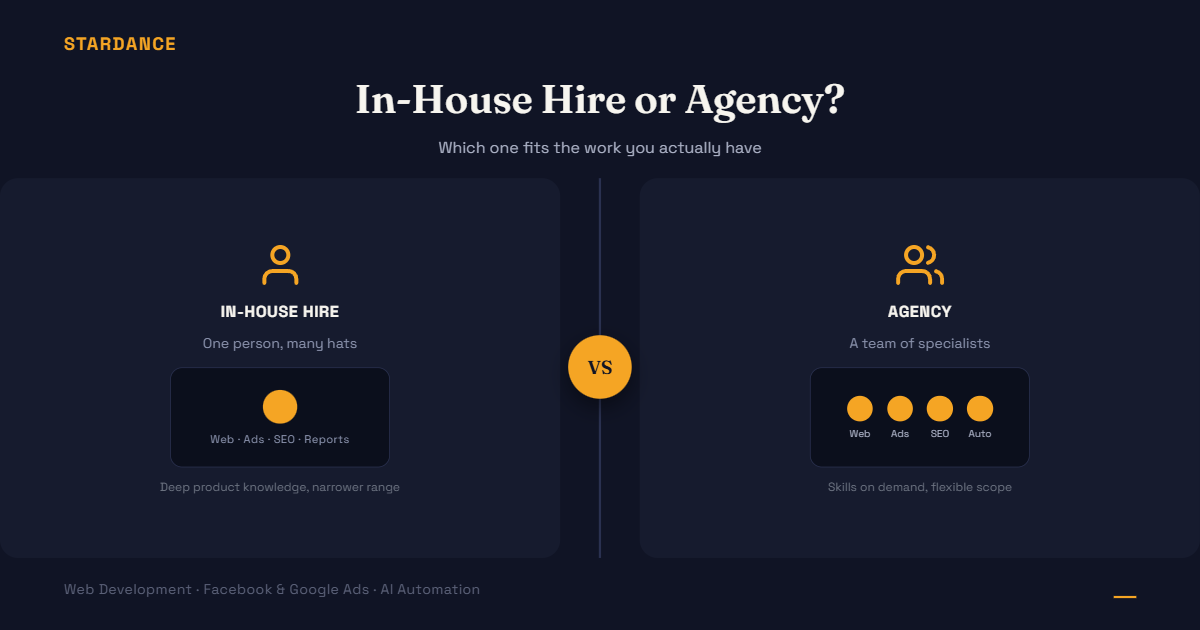
You’re doing the marketing yourself between everything else, or you’ve asked a junior staff member to “handle the website, the ads and the social media.” Results are patchy, and every month you wonder whether it’s time to hire properly or hand it to an agency. The answer depends less on budget than on what kind of work you have and how much of it there is.
What an in-house hire really costs
The salary is the visible part. The full cost is more:
- Salary, which for a junior marketing executive in the Klang Valley is often in the low-to-mid thousands of ringgit a month.
- Statutory costs on top: employer EPF, SOCSO and EIS.
- Tools and software: design, analytics, email, scheduling, and automation, often per seat.
- Recruitment and training time, including the months before a new hire is fully productive.
- Your management time, which is easy to forget and often the largest hidden cost for a busy owner.
- Single-point-of-failure risk. When that person is on leave, resigns, or is simply weak in one area, that part of your marketing stops.
The bigger issue is range. One person is rarely good at web changes, ad management, tracking, SEO and automation at once. You end up with someone who’s average at five things, not strong at the one that matters most this quarter.
What an agency retainer gives you, and what it doesn’t
What you get:
- A team with different specialties, so you pay for the skills you need without hiring each one
- Tools and tracking set up already
- Experience from many accounts, so mistakes someone else already made don’t become yours
- Flexibility: scale the scope up or down without hiring or firing
What you give up:
- Daily presence. An agency won’t know your products as deeply or react as quickly as someone who sits beside your team
- Control over priorities. You need a clear brief, KPIs, and regular reporting
- A cost that can look higher per month than one salary, though it usually covers far more skills
Signs it’s time for an agency
- Marketing is the owner’s side job. If you’re the one editing the website and checking ads at night, your time is already being spent at a poor rate.
- Your one marketing hire is stretched across too many jobs, and no part of the work is getting done well.
- Results have stalled and nobody can say why. That usually means missing tracking, no testing process, or a skills gap, all of which an agency can audit.
- You need specialist skills only occasionally, such as conversion tracking, a site rebuild, a workflow automation, or an SEO overhaul. A full-time hire for a project that finishes in three months is expensive.
- You’re spending on ads without ad expertise, and you can’t tell whether the cost per lead is good or bad.
- Hiring is taking longer than the problem can wait. A good agency can start in weeks. A good hire can take months to find and more to settle in.
- You’ve lost momentum before when someone left and nobody else knew the logins, the campaigns or the reasoning.
Signs to keep it in-house
An agency isn’t always the answer. In-house works better when:
- You have steady, high-volume daily work such as community management, constant content creation, or customer chat
- The work depends on deep product knowledge that takes a year to learn
- There’s enough work to keep a specialist busy full time
- You want control over every message and are prepared to manage the person well
The middle path most SMEs end up on
Many businesses do both: a coordinator or marketing executive in-house who owns the brand, content and daily communication, plus an agency for the specialist work, such as web development, ad management, tracking, SEO and automation. The in-house person briefs and reviews. The agency does the technical, measurable parts. It avoids the cost of hiring four specialists while keeping someone who knows the business.
How to compare the real costs
Use the same formula for both options over 12 months:
| Cost item | In-house | Agency |
|---|---|---|
| Salary or retainer x 12 | [RM] | [RM] |
| EPF, SOCSO, EIS | [RM] | Included in the retainer |
| Tools and software | [RM] | Often included |
| Recruitment and training | [RM] | None |
| Your management time | [hours x your hourly value] | Usually less |
| Ad spend | Separate | Separate |
| Skills covered | One person’s range | Several specialties |
Ad spend appears in both columns because it doesn’t change with the option you pick. What changes is how well that money is used.
Before you hire an agency
- Write down what you want: leads, sales, bookings, or a rebuilt site, with a number attached.
- Ask for reporting you can understand: leads, cost per lead and conversion rate, not just reach and impressions.
- Start with a defined scope, such as an audit or one campaign, before committing to a long retainer.
- Ask who actually does the work, and who you’ll speak to.
Where this fits across what we do
Whichever way you go, the same four areas decide results: a website built to convert, ads that are tracked to cost per lead, automation that gets enquiries to the right person quickly, and search and AI visibility so customers can find you without paying for every click. An agency can cover all four under one plan. An in-house hire usually covers one or two well.
Not sure whether an agency, an in-house hire or a mix fits your business? Tell us what you’re doing now and we’ll give you an honest view. [See how we work with growing businesses →]