
16 October 2026
How We Built MyPetVillage: A Pet Personality Site
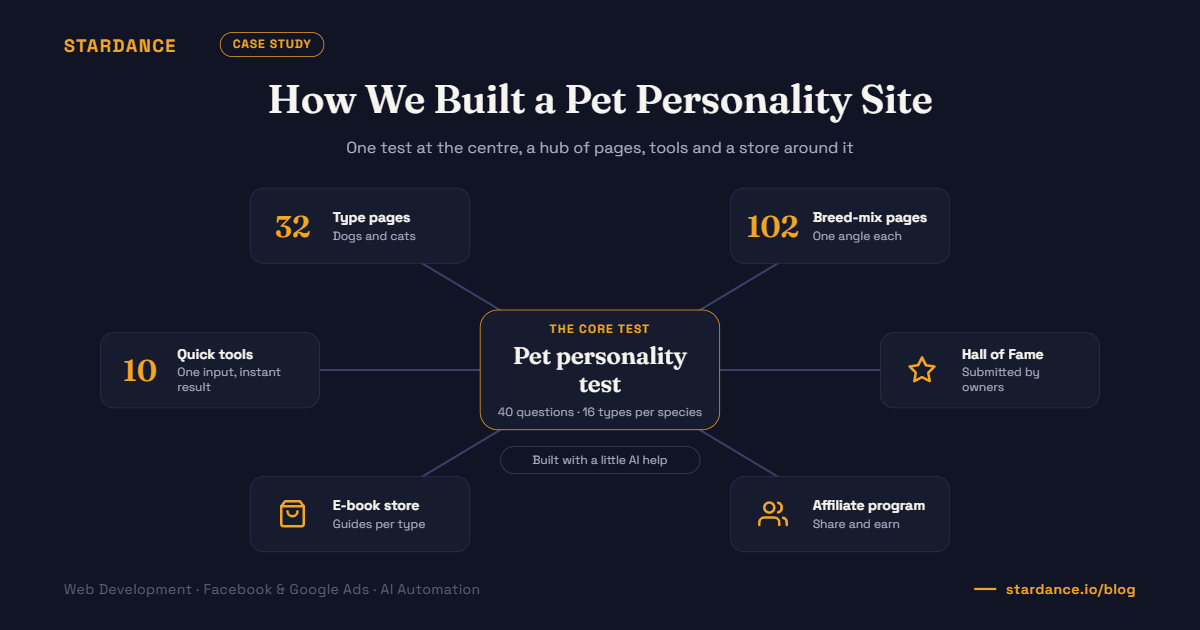
Pet owners love to say their dog is “such an introvert” or that their cat has “main character energy.” We built a site that turns that into something fun: a free personality test for dogs and cats, with a set of tools, guides and pages around it. This is a look at how we approached each part, and what we’d tell anyone planning a similar build.
A quick note: MyPetVillage is not affiliated with the Myers-Briggs Company.
The brief: one test, many ways in
The core idea was simple: an MBTI-style personality test for pets. But a single test page is a thin site. It gets visitors once, and search engines have little to rank. So we planned it as a hub: the test at the centre, with pages and tools around it that each answer a different question a pet owner might have, and each leads back to the test.
The core test: 40 questions, about 5 minutes
What we built: a free test for dogs or cats, 40 questions, about five minutes, producing one of 16 personality types per species.
How we approached it:
- Length. Short enough that people finish, long enough that the result feels earned. Forty questions in around five minutes was the balance we chose.
- Mobile first. Most people will answer on a phone, so one question at a time, large tap targets, no typing.
- Separate paths for dogs and cats, so the questions read naturally for each animal instead of using one generic list.
- The result is the product. The result page is what people screenshot and share, so it got the most design attention.
- Honesty built in. The entertainment-only disclaimer and the lack of affiliation with the Myers-Briggs Company are stated plainly, not buried.
The 32 personality-type pages
What we built: one page for each of the 16 types, for dogs and for cats, so 32 in total.
How we approached it: these pages are what people land on from search (“what does an INFP dog look like”), so each one had to stand alone, not just serve as a results screen. We used one consistent page structure and wrote the content for each type separately. Reusing a template is fine, but swapping a few words between 32 pages produces near-duplicate content, which search engines ignore and visitors notice.
The 102 mixed-breed pages
What we built: 102 pages covering mixed-breed combinations.
How we approached it: this is where scale becomes a risk. A hundred-plus pages built from a template can easily become thin and repetitive. We treated each combination as its own page with its own angle, and linked them to the relevant type pages so visitors and search engines can move between them. [Confirm how the 102 combinations were chosen, for example by search demand or by popularity.]
The tools: small, single-purpose, instant
What we built: a set of lightweight tools around the main test:
- Pet Vibe Quiz
- Pet as Human
- Pet Compatibility Checker
- Pet Mood Decoder
- “Is My Pet Normal?”
- Pet Age Converter
- Pet Happiness Checker
- Pet Life Stage Explorer
- Pet Name Generator
- Pet Personality Radar
How we approached it:
- One input, one instant result. Each tool does a single job, with almost no setup, so someone can try it in seconds.
- Every tool is an entry point. People search for “dog years to human years” or “cat name ideas” long before they search for a personality test, so each tool catches a different search and leads to the main test.
- Built to be shared. Results are designed to look good in a screenshot or a message to a friend.
- Care with the sensitive ones. Tools like “Is My Pet Normal?”, the Mood Decoder and the Happiness Checker touch on pet wellbeing. We framed them as light, informational guides, not veterinary advice, and say plainly that a vet should be consulted for health concerns.
The Hall of Fame
What we built: a gallery where owners can submit their own pets.
How we approached it: it gives visitors a reason to come back and a way to show off. User submissions need decisions about photo handling, moderation and consent, so we kept the flow simple and treated moderation as part of the feature, not an afterthought. [Confirm how submissions are reviewed.]
The store: e-book guides
What we built: a store selling personality guides as e-books.
How we approached it: the guides are the natural next step after a result. Someone who has just learned their dog’s type is the most interested they’ll ever be. We kept the price low and the checkout short, and tied each guide to a specific type.
The affiliate program
What we built: an affiliate program paying 50% commission.
How we approached it: pet owners already share their results, so we gave the people who do that a way to earn from it. The essentials are a unique link per affiliate, reliable tracking, plain terms and a clear payout process. A tracking mistake in an affiliate program costs trust fast, so it was tested before launch.
How this connects to what we do
A project like this touches most of what we offer: the website itself, search and AI visibility for 130+ pages, tracking and automation behind the store and affiliate program, and the ads and content that bring people in. If you’re planning a site with a lot of pages, tools or interactive features, we’d be glad to talk through the approach.
Planning a site with a core feature, supporting pages and a way to earn from them? Tell us the idea and we’ll tell you how we’d build it. [See how we approach web development projects →] You can see the finished site at mypetvillage.com.