
7 October 2026
How to Run a ChatGPT Ads Test Without Wasting Your Budget: A 5-Step Plan
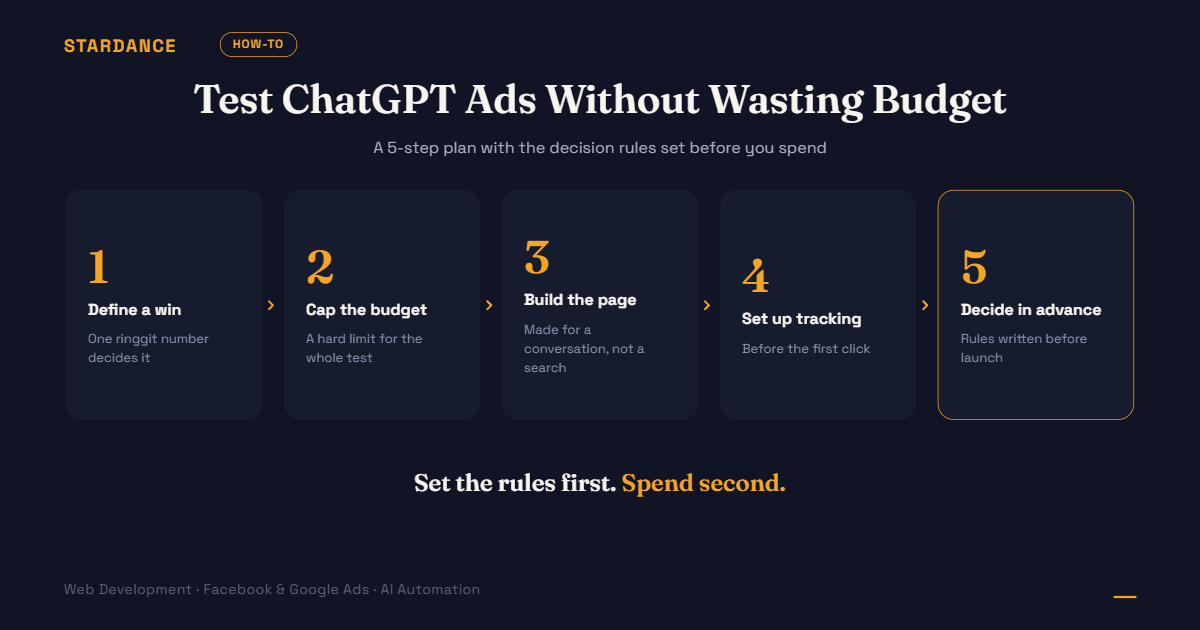
ChatGPT ads are new, which means there are no reliable benchmarks, no proven playbooks, and very little public data on what a good result looks like. That doesn’t make them off-limits. It means the first campaign should be a controlled experiment with a decision rule set before any money is spent.
Step 1: Define what a win looks like before you spend
Write down one number, in ringgit, that decides whether the test succeeded.
- Your current cost per lead (CPL) on Google or Facebook is the baseline. Pull it from the last 60-90 days.
- Your ceiling for the test is the highest CPL you’d accept from a brand-new channel. Many businesses allow a premium for learning, such as [X]% above their current CPL. Pick your own number.
- Your minimum sample. Decide how many leads you need before judging, because five leads is noise, not evidence.
If you can’t write these three numbers down, you aren’t ready to spend yet.
Step 2: Set a capped test budget you can afford to lose
- Fund the test from your experimental budget, not from campaigns that already produce leads at a known cost.
- Set a hard cap for the whole test, not just a daily limit, so a mistake can’t run unchecked.
- Plan for a fixed window, such as 3-4 weeks, so you aren’t judging a channel on its first few days.
Step 3: Build a landing page for a conversation, not a search
Someone who clicks an ad inside an AI chat has usually just described their situation in detail. They expect continuity.
- Answer the likely question in the first screen. If the ad was relevant to “how much does a website rebuild cost,” the page should address cost, not your company history.
- Keep the page narrow. One topic, one clear next step, a short enquiry form (name, phone, one qualifying question).
- Make it work on mobile first, since much of this traffic may be on phones.
- Use specific proof near the form, such as a short testimonial or a plain description of what happens after someone enquires.
Step 4: Set up tracking before the first click
This is where most tests quietly fail. Before launch:
- Confirm what conversion tracking the platform supports.
- Add a unique tag to the ad’s destination URL (UTM parameters) so the traffic is identifiable in your analytics regardless of platform support.
- Make sure every lead source, including form submissions, WhatsApp clicks, and calls, is logged somewhere you can filter by channel.
- Ask new leads how they found you. It’s a low-tech check on what the numbers say.
If you can’t see leads and cost per lead for this channel, you can’t judge the test. In that case, treat spend as a brand-awareness experiment and cap it accordingly.
Step 5: Decide in advance what happens next
Write the decision rules down before launch, so a hopeful week-two lead doesn’t change the standard:
| Result at the end of the window | Next step |
|---|---|
| CPL at or below your ceiling, enough leads to trust it | Extend the test, increase budget gradually |
| CPL above your ceiling, but lead quality is strong | Adjust the landing page or offer once, then retest |
| CPL above your ceiling, weak lead quality | Stop and put the budget back into proven channels |
| No usable data (tracking gaps, too little volume) | Fix measurement first, then decide whether to rerun |
Judge lead quality as well as cost. Ask your sales team whether these leads were real prospects, because a cheap lead that never answers the phone isn’t cheap.
What not to do
- Don’t promise your boss or your clients specific results from a channel this new.
- Don’t scale a test because the first few days looked good.
- Don’t cancel working campaigns to fund it.
- Don’t assume results from Google or Facebook will transfer, since intent and audience here may behave differently.
Want a test plan built around your own CPL baseline and a landing page matched to the conversation, with tracking in place before launch? [See how we manage ChatGPT ads →]