
6 October 2026
How to Check If ChatGPT, Perplexity, and Google AI Overviews Recommend Your Business (A 30-Minute DIY Audit)
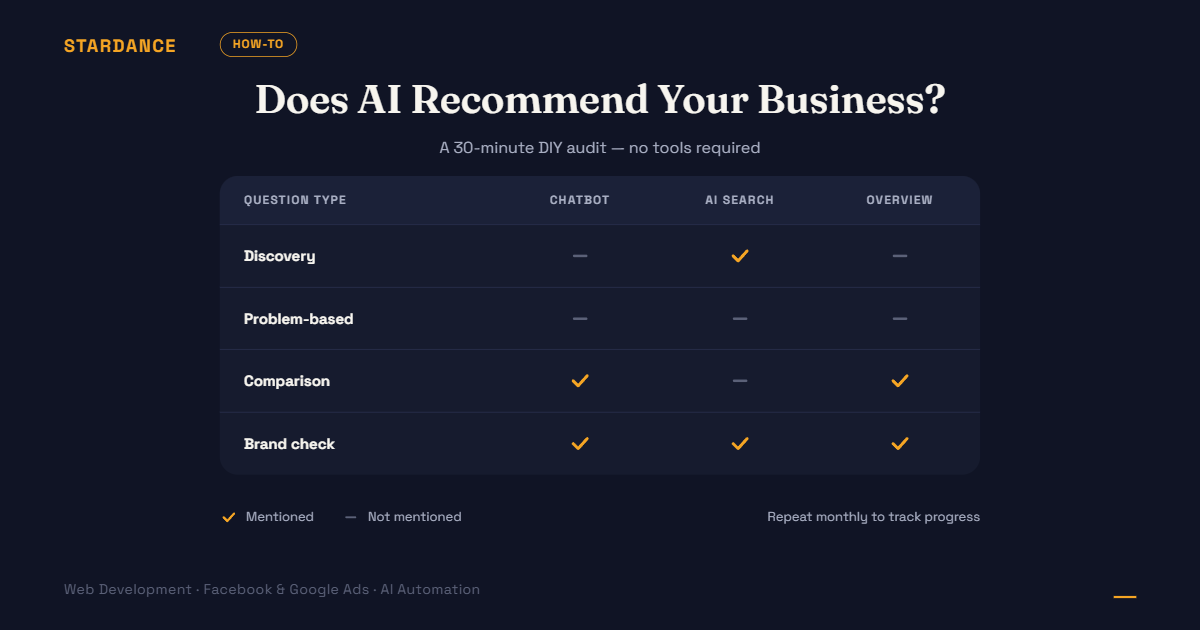
When a customer asks an AI assistant for “the best renovation contractor in Petaling Jaya,” does your business come up? Most owners have never checked. You don’t need a tool or an agency to find out. You need about 30 minutes and a spreadsheet.
Step 1: Write the questions your customers actually ask
Write 10 questions in three groups:
- Discovery (4 questions): “best [your service] in [your area],” such as “best dental clinic in Bangsar” or “affordable corporate gift supplier in KL.”
- Problem-based (3 questions): what someone asks before they know who to hire, such as “how do I choose a renovation contractor in Selangor?”
- Comparison and brand (3 questions): “[your business] vs [competitor]” and “is [your business] good?”
Write a few of them in Bahasa Malaysia too. Your customers may ask in either language, and AI tools can answer the two differently.
Step 2: Run them in more than one tool
Ask each question in ChatGPT, Perplexity, and Google’s AI Overviews or AI Mode. Gemini is worth adding if your customers use it. Two practical tips:
- Use a logged-out or private window where you can. Answers can be shaped by your history and location, and you want to see what a stranger sees.
- Run each question twice. AI answers vary between runs, and one answer is an anecdote, not a result.
Step 3: Log what you see
For each answer, record:
| Question | Tool | Mentioned? | Linked as a source? | Who appeared instead? | Is the info about you accurate? |
|---|
The last two columns matter most. If a competitor shows up repeatedly, note which websites the AI cites for them. Those are the sources influencing the answer, and they’re often directories, review sites, and articles rather than the competitor’s own website.
Step 4: Read the pattern
- Not mentioned anywhere: AI tools don’t have enough clear, citable information about you. The fixes are in step 5.
- Mentioned, but the details are wrong (old address, discontinued service, wrong pricing): find which source holds the wrong information and correct it there.
- Mentioned on some tools but not others: normal. Each tool pulls from different sources, so don’t treat one result as your overall status.
- Competitors always appear: look at what they have that you don’t, such as reviews, directory listings, or articles that mention them.
Step 5: Fix the basics first
These support both traditional SEO and AI visibility, so they’re worth doing whatever you find:
- Make your website state plainly what you do, where, and for whom. Vague positioning gives AI tools nothing to quote.
- Answer real customer questions directly on your pages, in a short FAQ-style format.
- Keep your Google Business Profile accurate and active, including hours, services, and photos.
- Keep your business name, address, and phone number consistent across directories and listings.
- Earn mentions and reviews on third-party sites. AI answers often draw on sources beyond your own website.
- Add structured data (schema markup) so machines can read your business details reliably.
What this audit can’t tell you
It isn’t a ranking report. There’s no stable “position 3” in an AI answer, and results change with the tool, the wording, the location, and the day. Treat your log as a directional snapshot, and repeat it monthly to see whether things are improving. Be wary of anyone who sells guaranteed placement in AI answers. No one controls those systems.
Want a deeper audit of how AI tools see your business, with a prioritized fix list? [See how we approach SEO, GEO, AEO, and AI optimization →]