
23 October 2026
How Much Should a Malaysian SME Budget for Facebook and Google Ads?
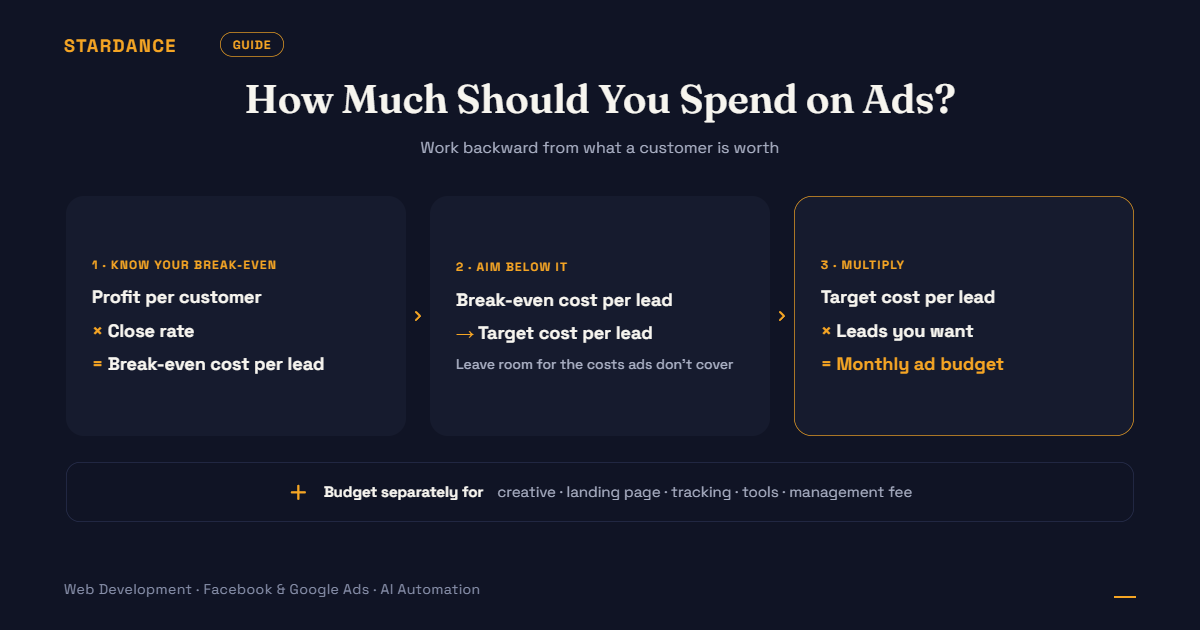
“How much should I spend?” is the first question most owners ask about ads, and the answer they usually get is “it depends.” That’s true, but it isn’t useful. Here’s what it depends on, how to turn it into a number for your own business, and what that number should and shouldn’t include.
The honest answer: work backward from your goal
There’s no correct monthly figure for everyone. A budget that’s too small to learn from wastes money, and a budget that’s too big for your sales process wastes it faster. The fix is to build the number from your own economics, not from a rule of thumb.
Step 1: Work out what a customer is worth
You need three numbers:
- Profit per customer: the average sale minus what it costs you to deliver
- Close rate: the share of leads that become customers
- Break-even cost per lead (CPL): profit per customer × close rate
Step 2: Set a target CPL below break-even
Break-even is where you stop making money, so aim well under it. Many businesses set a target of half or less of break-even, to leave room for the costs ads don’t cover.
Step 3: Multiply by the leads you want
Budget = target CPL × leads you want per month.
An illustration, with made-up numbers (these are not benchmarks):
| Item | Example |
|---|---|
| Average sale | RM2,000 |
| Profit margin | 40%, so RM800 profit per customer |
| Close rate | 20% of leads become customers |
| Break-even CPL | RM800 × 0.20 = RM160 |
| Target CPL (half of break-even) | RM80 |
| Leads wanted per month | 30 |
| Monthly ad budget | 30 × RM80 = RM2,400 |
Use your own figures. If you don’t know your close rate yet, start with a conservative guess and update it after a month of real data.
Step 4: Check it’s big enough to learn from
A budget can be correct on paper and still too small to work. Ad platforms need enough results to learn who responds, and a few dollars a day spread across several audiences gives them too little to learn from. If your target budget is very small, run fewer campaigns with more spend each, not many thin ones.
Indicative starting ranges by industry
These are rough starting points for a monthly ad spend, not promises. Costs vary with competition, offer, creative and landing page.
| Industry | Indicative monthly starting spend | What pushes the cost up or down |
|---|---|---|
| E-commerce | RM1,500 to RM5,000 | Product price, repeat purchases, how crowded the category is |
| F&B and outlets | RM1,000 to RM3,000 | Location, offer strength, number of outlets |
| Property | RM2,000 to RM6,000 | Project value, buyer intent, lead quality |
| Clinics and wellness | RM1,500 to RM4,000 | Treatment value, local competition, ad policy limits on health claims |
| Education and courses | RM1,500 to RM4,000 | Intake periods, course price |
| B2B and professional services | RM2,000 to RM6,000 | Deal size, long sales cycles, Google-heavy demand |
What the budget should and shouldn’t include
Keep these costs separate so you know what your money is doing:
- Ad spend: what goes to Meta and Google. Check whether tax applies on your ad invoices.
- Management fee: what an agency or freelancer charges to run the account. This is not ad spend.
- Creative: photos, video and copy, which need regular refreshing.
- Landing page and tracking: a page that converts and tracking that works. These decide how much of your ad spend turns into leads (see our post on why cost per lead rises).
- Tools: analytics, forms, automation and CRM.
A common mistake is putting the whole marketing budget into ad spend and nothing into the page or tracking, then wondering why the leads are expensive.
How to split it between Facebook and Google
Start from how your customers buy. If they search for what you sell, Google deserves more of the budget. If they need to be shown the product or discover you, Facebook and Instagram usually take more. If you’re unsure, test both with a small budget and compare cost per lead. We cover the difference in our post on Facebook Ads vs Google Ads.
Plan for Malaysia’s calendar
Costs and demand shift through the year:
- Hari Raya, Chinese New Year, 11.11 and year-end sales bring more advertisers into the same audiences, so cost per click often rises.
- School intakes, property launches and festive dining create peaks for some industries.
- Plan early: build creative and raise budgets before a peak, not during it, and compare results with the same period last year, not the previous month.
When to raise it
- When your tracked cost per lead has held at or below target for several weeks
- When lead quality is good, meaning the leads are being contacted and are turning into customers
- When your team can respond quickly to more leads
Raise it in steps, not all at once, so the results have time to settle.
When not to spend more
- Tracking is unreliable, so you can’t tell which leads came from ads
- The website or landing page loses most of the visitors (see our post on signs your website is losing leads)
- Leads sit unanswered for hours
- You have no idea what a lead is worth
In these cases, more spend usually buys more waste. Fix the leak first.
A starting plan
- Work out profit per customer and close rate, even roughly.
- Calculate break-even CPL and set a target below it.
- Decide how many leads you can handle per month.
- Budget = target CPL × leads, then add creative, page and tools.
- Run it for long enough to judge, then adjust from real numbers.
Not sure what your ad budget should be, or want your current spend checked against your numbers? [See how we run Facebook and Google Ads campaigns →]