
30 September 2026
FAQ: What’s a Webhook, and Why Does It Matter for Automating My Business?
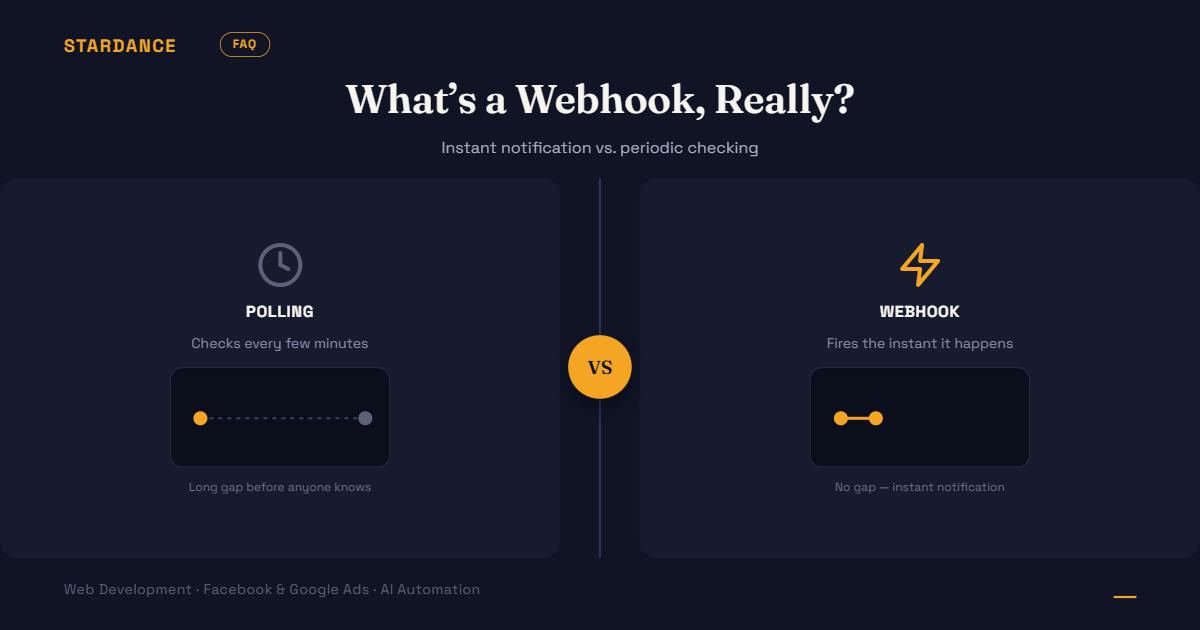
You’ve heard the word in an automation pitch or a developer’s explanation, nodded along, and moved on. Here’s the actual answer short enough to remember.
What is a webhook?
A webhook is a way for one system to instantly tell another system “something just happened”, without anyone checking manually or waiting for a scheduled check.
Instead of one app repeatedly asking another “anything new yet? anything new yet?” every few minutes (called polling), a webhook flips it around: the moment something happens, the first app immediately sends a message to the second app saying so. It’s the difference between refreshing your email every five minutes versus getting a notification the instant something lands.
A plain example
Someone submits your website’s contact form. With a webhook connected:
- The moment they hit “submit,” your form software sends a message to whatever tool handles what happens next
- That tool receives it instantly. No delay, no waiting for a scheduled check
- It can then do something automatically. Notify your team, log the enquiry, kick off a follow-up
Without a webhook, the same result usually means someone checking an inbox manually, or a scheduled task that only runs every so often, meaning a real gap between “customer submitted a form” and “someone actually knows about it.”
Why it matters for automating your business
Webhooks are what makes instant automation possible, instead of delayed automation. A lead-routing workflow that fires the second a form is submitted needs a webhook behind it. A workflow that only checks every 15 minutes is running on polling, and that gap is often exactly where a customer gives up and enquires with a competitor instead.
If speed of response matters to your business, and for most SMEs, it directly affects whether a lead converts. Webhooks are the mechanism that makes “instant” actually instant, rather than “instant, with an unpredictable delay.”
Do you need to understand the technical details?
No. As a business owner, the only thing that actually matters is this: when someone sets up an automation for you and says it’s “webhook-based,” that means it reacts the moment something happens, not on a delay. If a quote or workflow description says it checks periodically instead, ask whether a webhook-based version is possible, the difference in real-world response time can be significant.
Want your lead notifications running the instant someone enquires, not on a delay? [See how we build automation workflows →]