
21 October 2026
Case Study: How a KL E-commerce Brand Cut Its Cost Per Lead by Fixing Its Ad Creative
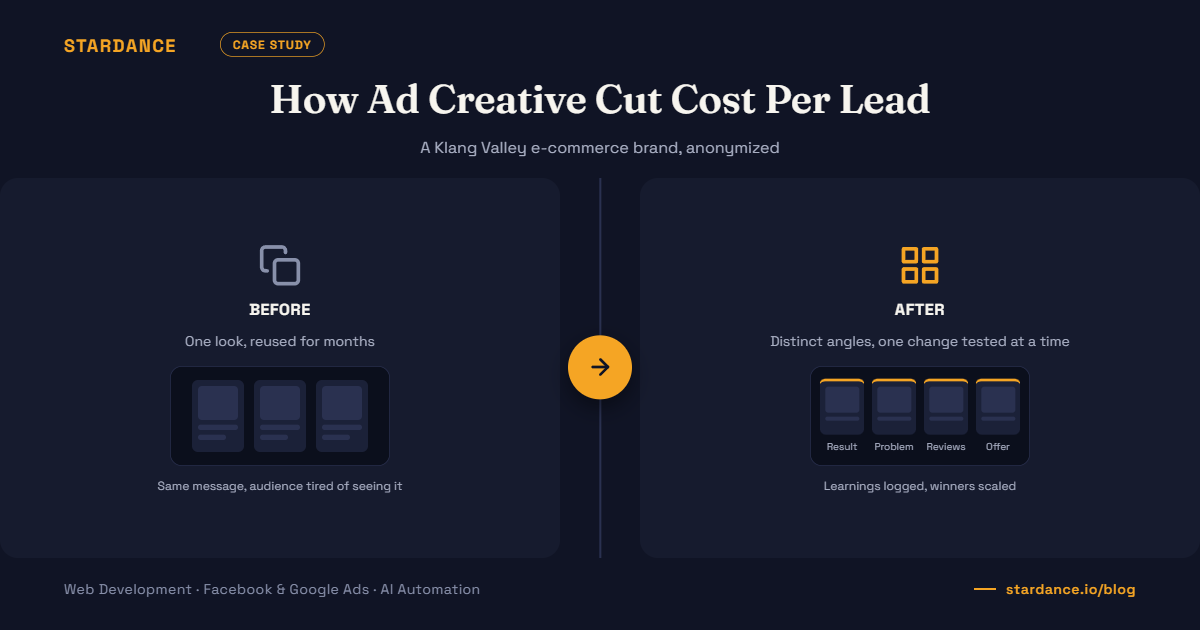
An online retailer based in the Klang Valley was spending steadily on Facebook and Instagram ads. Traffic and clicks looked healthy, but the cost of each lead kept creeping up. The audience and budget hadn’t changed much. The creative had. Here’s what we looked at, what we changed, and what happened.
The client is anonymized and shared with their permission.
The situation
The brand sells online to customers across Malaysia. Their ads were run in-house, with a handful of images reused for months.
Before:
- Monthly ad spend: RM 3,000
- Leads per month: 135
- Cost per lead: RM 37
- Period measured: 3 months
What we found
When we audited the account, the problem wasn’t the targeting. It was the creative.
- A small pool of ads shown to the same people for too long. Clicks had become more expensive as the audience tired of seeing the same images. (We cover this in our article on why cost per lead rises.)
- Every ad said the same thing. Product photos on a plain background, with the same offer in the caption, so there was nothing to learn from comparing them.
- The first second did no work. Nothing in the opening frame or headline stopped a scroll or said who the ad was for.
- One language for everyone. The copy was written in English only, though the customer base reads both English and Bahasa Malaysia.
- No record of what had been tried, so nobody knew which ideas had already failed.
What we changed
We treated creative as a testing program, not a one-off design job.
1. Split the ideas by angle, not just by look. Instead of five versions of the same photo, we wrote eight distinct angles, such as:
- Product in use, showing the result
- A customer problem and how the product solves it
- Social proof, such as reviews or real customer photos
- The offer, stated plainly
2. Test one change at a time. Each round changed a single element (the opening line, the image, the offer, or the call to action) so we knew what caused any difference.
3. Make the first moment count. We rewrote openings so the first line and first frame said who the ad was for and what they’d get, with video where it suited the product.
4. Test language. We ran mixed versions to see which each audience responded to.
5. Keep a testing log. Every ad got a note: the idea, what we expected, and what happened. Winners were scaled, losers were retired, and what we learned guided the next round.
6. Match the landing page to the winner. Ads that promised a specific offer sent people to a page showing that offer, not the homepage.
The result
After 3 months:
- Monthly ad spend: RM 5,000
- Leads per month: 210
- Cost per lead: RM 23.80
- Change in cost per lead: 64%
What we learned
- Creative is usually the biggest lever once targeting is reasonable, and it’s the one most often left alone.
- Testing different ideas beats testing different colors. Changes in message tend to teach more than changes in style.
- Fatigue is predictable. Plan new creative before performance drops, not after.
- A log turns guesses into knowledge. The next campaign starts from what’s already proven.
What this means for your ads
If your cost per lead has been rising and you haven’t refreshed your ads in months, creative is the first place to look. Before changing the budget or audience, ask:
- How many different ads are running, and how old are they?
- Do they differ in message, or only in look?
- Do you know which ideas have already been tried?
- Does the landing page match what the ad promises?
If you can’t answer these, that’s a useful place to start.
Want your ad creative and tracking reviewed before you spend more? [See how we run Facebook and Google Ads campaigns →]