
12 October 2026
“Can You Make It Like This Website?” How We Turn a Reference Site Into a Better One for Your Business
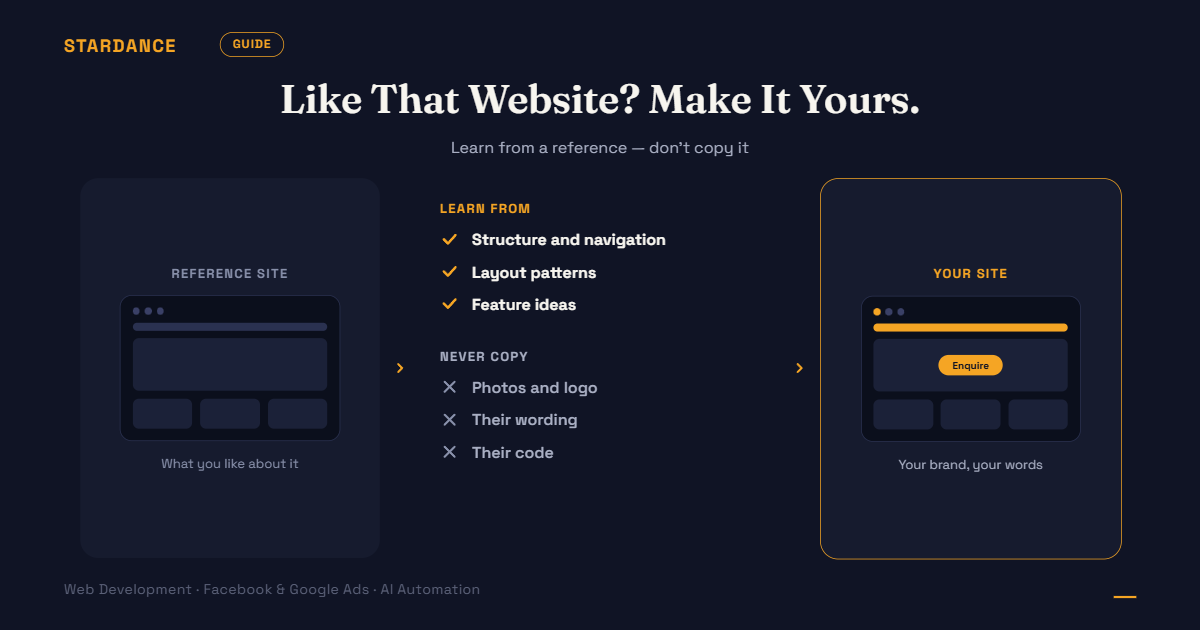
Almost every web project starts the same way. The client sends a link and says, “I want something like this.” Sometimes it’s a competitor, sometimes a big brand, sometimes a site they saw once and liked. It’s a good way to start, and it’s a risky way to finish. Here’s how to use a reference site properly, so you get the result you imagined without copying anyone.
Why reference sites are useful
Most owners can’t describe a website in words, but they know one when they see it. A reference does three things that a written brief can’t:
- It shows your taste faster than a paragraph of adjectives.
- It shows what you expect to get, including the level of polish and how much content you think a site needs.
- It shows features you assume are simple, like a booking calendar, a live chat, or a product filter, so they can be quoted properly instead of discovered halfway through.
An agency that asks for references isn’t being lazy. It’s saving you a round of revisions.
The problem with “just copy it”
If the request really is “copy it exactly,” there are four problems:
- Copyright. Original code, written text, photography, illustrations and custom graphics are generally protected. Using them without permission can lead to takedown notices or legal claims.
- Search penalties. Copied text is duplicate content. Search engines usually rank the original and ignore or demote the copy, and AI tools are unlikely to cite a site that repeats someone else’s words.
- Brand confusion. A site that looks identical to a competitor’s makes you look like a follower, or worse, like an imitator. Customers who notice remember it.
- It may not fit your business. A reference site was built for its owner’s customers, products and goals. Their layout may suit a company with 10,000 products and fail for yours with 12 services.
Layout patterns, navigation ideas and feature types are different. They’re common across thousands of sites, and borrowing them is how the web works. The line is between learning from a design and reproducing it.
What we actually do with a reference
When a client brings us a reference, we break it into parts and decide what to keep, what to change, and what to leave behind.
1. Ask what they like about it. “The whole thing” is rarely true. It’s usually one of these:
- The structure: how pages are organized and how visitors move through them
- The layout: spacing, hierarchy, how much is shown above the fold
- A specific feature: a quote calculator, a filter, a sticky enquiry button
- The tone: how the copy speaks to the customer
- The feel: the colors, type and imagery
2. Separate what’s reusable from what’s theirs.
| Part of the reference | Usually fine to learn from | Not ours to copy |
|---|---|---|
| Page structure and navigation | Yes | |
| Layout patterns and spacing | Yes | The exact visual design as a whole |
| Feature types (booking, filters, chat) | Yes | Their code |
| Tone and content strategy | Yes | Their actual wording |
| Colors and typography | General style | Their brand identity and logo |
| Photos, icons, illustrations | Always replace |
3. Check whether it suits your business. A reference might look great and still be wrong for you. We look at whether its goal matches yours (lead generation vs e-commerce vs brand awareness), whether your audience behaves like theirs, and whether it’s fast on mobile, since that’s where most Malaysian visitors are.
4. Build it original. The result takes the structure and flow you liked, applies your brand, your content and your customers’ questions, and often fixes things the reference gets wrong. Many references have slow pages, buried contact forms or no mobile polish. A good project keeps the strengths and drops the weaknesses.
Where clients’ references usually come from
- A direct competitor. Understandable, but the one most likely to make you look like a copy. We usually take the feature ideas and push the design in a different direction.
- A global brand. Great for polish, but their budget and traffic are different from yours. We pick out the parts that scale down.
- A regional marketplace or e-commerce site. Useful for product pages and checkout flows, particularly if local payment methods like FPX, GrabPay and Touch ‘n Go matter to your customers.
- A site from another industry. Often the best kind, because you bring something new to your market instead of repeating it.
Bring two or three, not one
One reference tends to become a template. Two or three let us see the pattern behind what you like. A good set has:
- A site whose layout you like
- A site whose features you want
- A site whose tone feels right
Add a short note for each: what you like, what you’d change, and anything that annoys you. “I like the menu but the pop-up drives me mad” is more useful than a link on its own.
Why this makes the project cheaper and faster
References take the guesswork out of scoping. When the brief is clear, quotes are more accurate, there are fewer revision rounds, and surprises like “I assumed it would have a members area” show up before the build, not after. If you’re comparing quotes, sharing the same references with every agency also makes the quotes comparable. (More on pricing: see our guide to what a business website costs in Malaysia.)
How the rest of your marketing fits in
A site built from a good reference works harder across everything else:
- SEO and AI search: original content and a clean structure are what search engines and AI tools reward. Copied pages work against you.
- Ads: landing pages modeled on high-converting structures, with your own offer and wording, can lower your cost per lead. Test and track them rather than assuming.
- Automation: if the reference has a smooth enquiry flow, we can pair it with automatic routing, so a new lead reaches the right person at once.
Before you send us a link
Prepare four things:
- 2-3 reference sites with a note on what you like about each
- One thing about each you’d change
- Your own goals: leads, sales, bookings or credibility
- Any must-have features you’ve seen elsewhere
We’ll tell you honestly which ideas will work for your business, which won’t, and how to make the result unmistakably yours.
Got a website you love and want something like it for your business? Send us the link and tell us what you like about it. [See how we approach web development projects →]